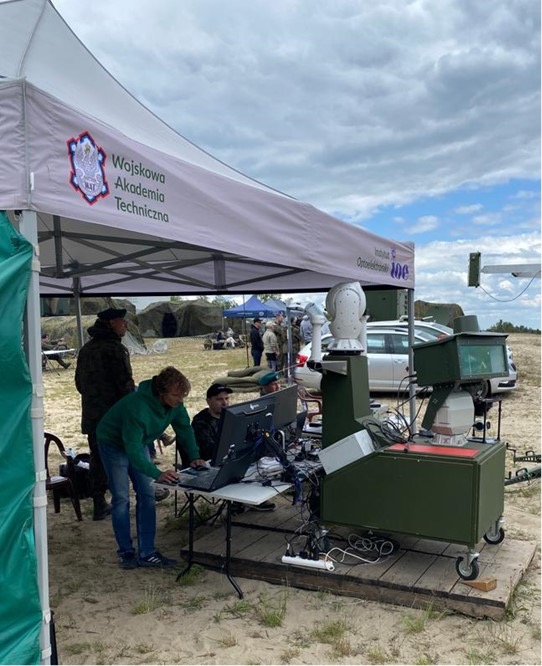

During the exercise, we demonstrated and tested systems that increase situational awareness of both individual soldiers and vehicles—specifically for detecting threats associated with laser radiation.
Together with the Warsaw University of Technology team, we presented a system for detecting battlefield radar radiation and a passive radar system. Both were developed by Professor Krzysztof Kulpa’s team at the Warsaw University of Technology and are intended to be included in the SOL-2A system.
We also showcased a laser-based drone detection system, SkanDRON, created under the project “Laser system for detecting and tracking low-flying objects (DOB BIO9/21/01/2018)” funded by the National Centre for Research and Development (NCBR).
This is a system for detecting laser radiation generated by rangefinders and laser target illuminators. It is designed for vehicle platforms that do not have such solutions already installed.
Since the system does not require any additional vehicle infrastructure to be installed, it can be used on civilian passenger and cargo vehicles—e.g., vehicles traveling in convoys. With the use of different data-transfer interfaces, radiation alarms can be displayed in an application running on a computer or smartphone.
The system correctly detected radiation from rangefinders operating at a wavelength of 905 nm, as well as the modern Vector PLRF25C rangefinder using “sub-noise” detection at a wavelength of 1550 nm. During the exercises, tests were also conducted for detecting radiation generated by a target illuminator used by a participant unit in the FEX exercise. The system correctly detected the illuminator radiation.
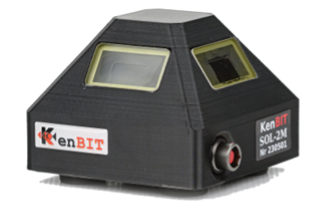
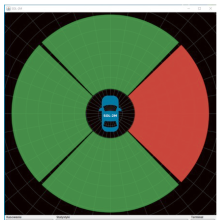
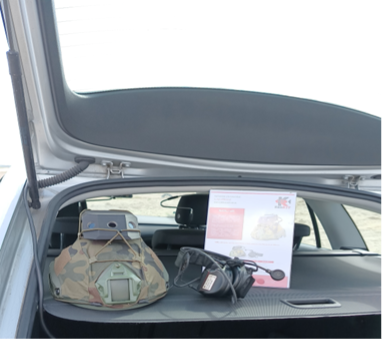
SOL-2I is a system for detecting laser radiation generated by rangefinders and laser target illuminators. The system is intended for a single soldier. Its compact design allows it to be mounted on a helmet or a tactical vest. The system is battery-powered. Information about detected radiation is delivered audibly via headphones connected to the device. It can use active hearing protectors or headphones from a personal radio station.
The system correctly detected radiation from rangefinders operating at a wavelength of 905 nm as well as the Vector PLRF25C rangefinder using “sub-noise” detection at a wavelength of 1550 nm.
The system enables the detection of various objects moving in the air, on land, and on water using radiation emitted by other systems—for example, TV stations or GSM transmitters. It successfully detects fighter aircraft, helicopters, drones, and missile threats, as well as land and maritime vehicles.
During the exercise, tests of the developed passive radar system were carried out. It detected and—via an application—enabled the location of the drones participating in other FEX scenarios. The system also successfully detected an F-16 aircraft at a distance of about 30 km.
The passive radar is intended to be an integral element of the SOL-2A system, whose expansion will increase the situational awareness of the vehicle crew on which it will be installed.
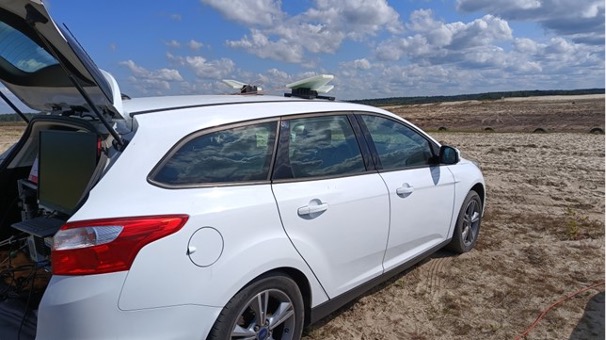
During the FEX exercise, we presented a radar radiation warning system.
As part of the tests, the radar of an F-16 aircraft was detected. The design development plan provides for expanding the construction into additional bands so that, in the target configuration, the system will detect radars operating in the X and Ku bands.
The radar radiation warning system will be integrated with the SOL-2A system, whose expansion will increase the situational awareness of the vehicle crew on which it will be installed.
The system was developed by a consortium consisting of:
- Military University of Technology (Leader)
- Air Force Institute of Technology
- KenBIT Sp. z o.o.
- Nordcom Sp. z o.o.
The system was created under the project “Laser system for detecting and tracking low-flying objects (DOB BIO9/21/01/2018)” funded by the NCBR.
The system enables drone detection from distances of up to 2 km. The detection range depends on the drone’s size. After detection, the system enables identification of the drone using day-light and infrared cameras. During the exercises, demonstrations of the system’s capabilities were conducted, including detections of drones participating in other FEX scenarios.