
Shipborne Public Address/General Alarm T-B
The Shipboard PA/GA T-B loudspeaker system provides both one-way and two-way shipboard communication—announcing verbal messages and alarms, and enabling communication between subscriber sub-stations, loudspeakers, and the MCS-20 panels.
The 100 V standard speaker lines allow a large number of loudspeakers to be connected. Return communication between subscriber sub-stations and the central equipment block is implemented via a digital line.
The loudspeaker system has been designed for public-addressing open decks and below-deck spaces on vessels. Its modular design makes it possible to install the system in different hardware configurations, depending on the requirements for the given type of vessel.
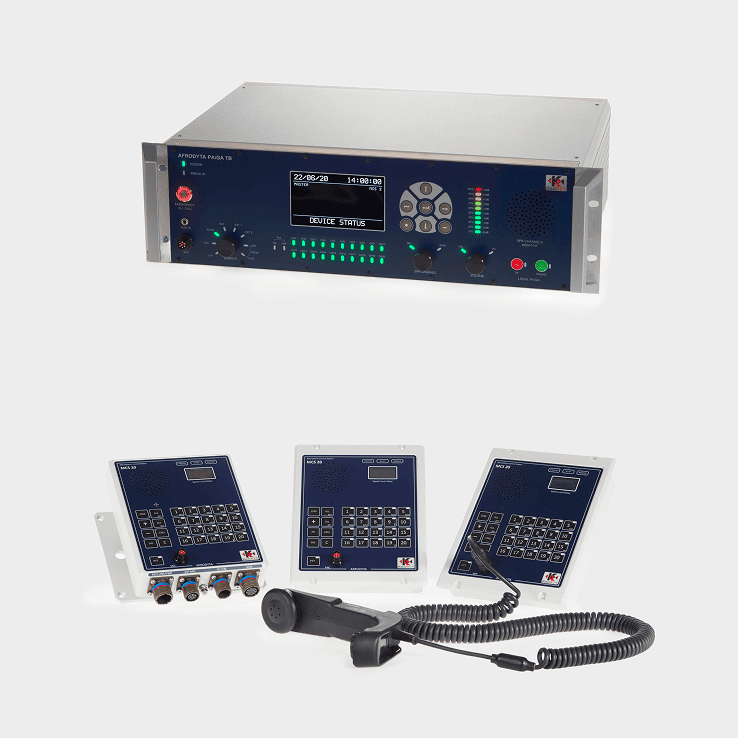
The design is based on proprietary solutions used in the Integrated Communications System (KenBIT product) and on experience gained over many years of servicing various shipboard public-address (PA) systems used on MW and NATO vessels.
The system works with the MCS-20 microphone control stations, the ACM-8 alarm panels, the MSB subscriber stations with the Talk-Back (T-B) system, cabin loudspeakers, and deck loudspeakers. The MCS-20 microphone panel (Microphone Control Station) was designed to meet the ship’s requirements and operational needs.
In 2021, our PA/GA Disposition (duty) public-address system and the AFRODYTA PA/GA T-B general alarm arrangement successfully passed EMC and environmental-mechanical tests (including resistance to salt fog), obtaining a Certificate of Type Approval from the Polish Register of Ships (download).
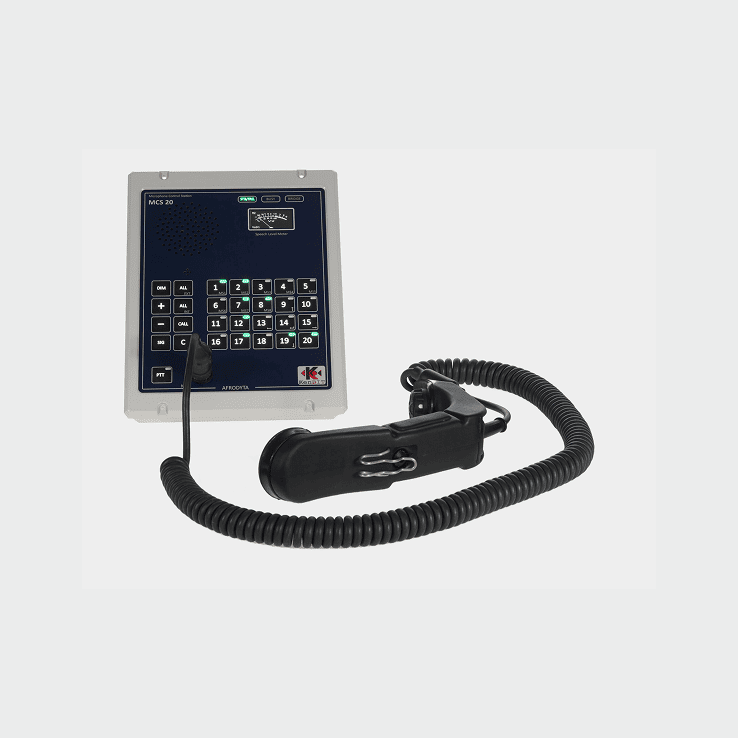
a monitor/speaker (listening loudspeaker).
a multifunction OLED display with a VU level-indicator.
system status indication: occupancy, deck microphone connection, and switching to standby mode.
status indication for each subscriber line using LED diodes in the line/zone selection buttons.
dedicated All out and All in buttons for transmitting collective PA announcements in living spaces and open decks.
intercom communication between MCS-20 panels, with a conference-call function.
the ability to broadcast messages from the built-in microphone in the MCS-20.
the option to connect a remote (external/“bridge”) microphone.
the ability to remotely control the entertainment panel (entertainment function).
a “SIG” button used to manually generate an alarm or to trigger the machinery alarm signaling.
adjustment of the monitor (listening loudspeaker) volume.
one-way communication, with a (PA – Public Address) mode for announcing messages and commands.
two-way communication, with a T-B (Talk Back) mode between the subscriber point (loudspeaker) and the MCS-20 microphone panel, enabling the calling of multiple subscribers simultaneously (Sel. Call).
broadcasting alarms using pre-programmed acoustic signals.
cooperation of the public-address system with the ship’s acoustic and optical signaling control systems.
retransmission of PA public-address messages to internal communication systems.
The alarm-signal generation unit includes a programmable shipboard alarm generator and, optionally, a programmable generator for verbal announcements
containing a CD player, a USB input for playing MP3 recordings, and 0 dBm line inputs (Line-In and AUX) for external signal sources. The entertainment panel is equipped with the capability for remote control from the microphone panel
Installed in configurations using 100 V or 70 V balanced/transformer-based speaker lines with an output step-up transformer. The amplifiers are configured to provide system redundancy (uninterrupted PA operation in the event of a failure of one of the amplifiers). The amplifiers will automatically switch to standby mode if the microphone panel is not used for more than a specified period (10 minutes)
Equipped with a speaker-line monitor/selection switch together with an amplifier level-indicator, and a switch for selecting the program/source. The panel allows local operation and local initiation of a general alarm
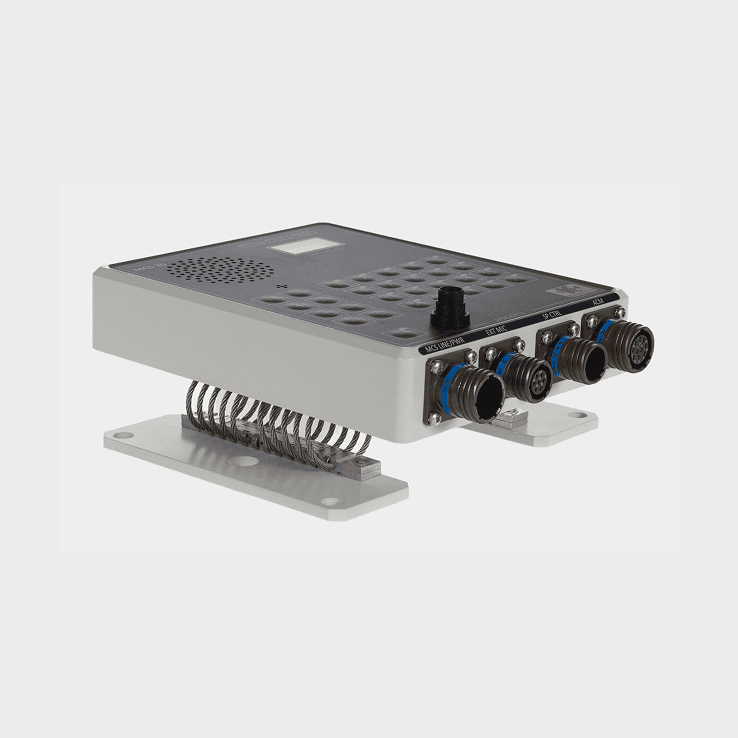
equipped with a connector assembly that enables efficient connection of shipboard cabling