
System Integrator (VoIP Gateway)
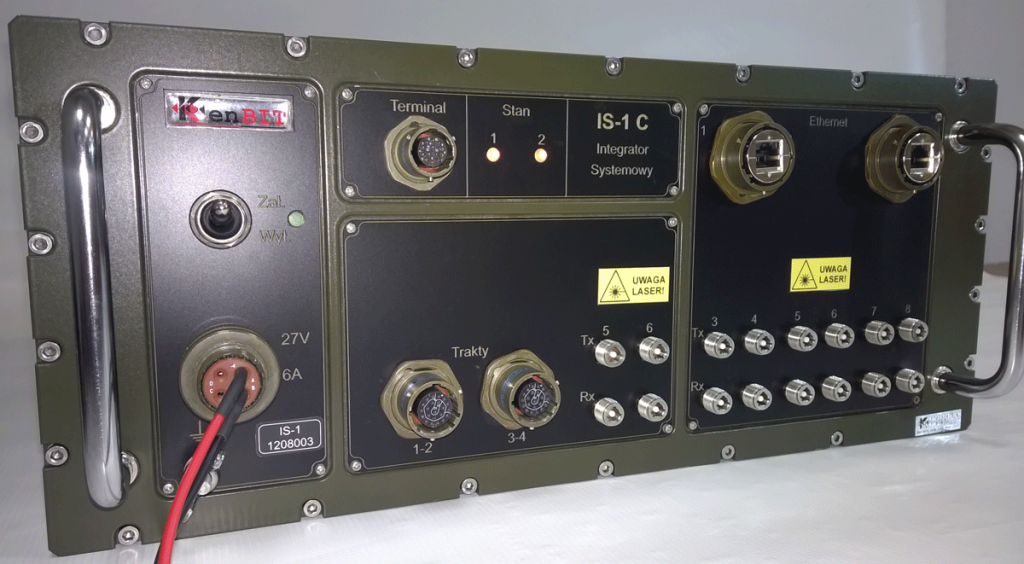
The System Integrator IS-1 is a key element of a field IP teleinformatics platform intended to support command and military operations and to build high-performance LAN networks installed in vehicles, developed for mobile conditions within Battlefield Management System (BMS) command systems.
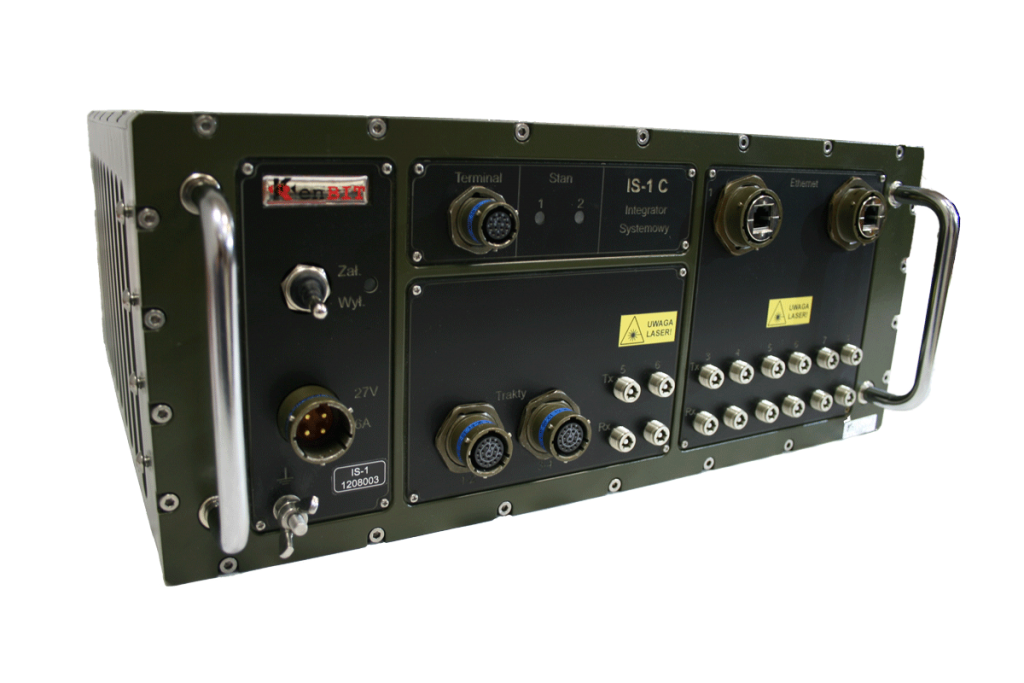
IS-1 is an IP gateway device of the WAN Access Box class. It integrates voice communications systems: VoIP telephony, analog telephony, inter-exchange trunks, and radio communications. It enables automatic exchange of IP data via wired connections (Ethernet, VDSL) and wireless connections, as well as via VHF and HF radio stations. It enables access communication between wired and radio communications systems. Its functional parameters, along with small size and low mass, allow the System Integrator IS-1 to be used both in stationary facilities and in mobile applications.
The IS-1 integrator performs the role of a teleinformatics integrator in command vehicles, combat vehicles (armored wheeled and tracked vehicles, and tanks), and other installations. It ensures, among other things, integration with VHF and HF radio stations and with field and stationary telecommunications networks, as well as integration with a set of vehicle sensors. IS-1 enables onboard internal communications. Its equipment may also include additional external components, for example: a WLAN module (wireless LAN), VoIP terminals, and network workstations, including tactical terminals.
The device is intended for operation in field conditions. According to classification N0-06-A101 and N0-06-A103, it is classified in group N.14-UZ-II-A. The permissible levels of spurious emissions and immunity to electromagnetic exposure meet the requirements specified in the Defence Standard N0-06-A200.
Subscriber lines |
Digital leased lines / digital circuits |
Ethernet interfaces |
VoIP telephony |
Router/switch functions |
Radio station support |
Automatic exchange of IP data |
Servers: DHCP, NTP, TFTP. |
Duplex conferences |
Power supply: 27 V DC. |
at Layer 2 and Layer 3. At Layer 3, IPv4 and IPv6 protocols are supported.
RIPv1 and v2, OSPFv2, BGPv4, EIGRP
DHCP, NTP, TFTP.
local console/desk, SNMPv3, WWW
according to IEEE 802.1Q
and configuring them to operate with a router or switch
PR4G, F@STNET
RKS 8000, RF 5800, AN/PRC-150, RKP 8100
RTK-1, Motorola XTL
compliant with STANAG 5066
KF/VHF (BSR function)
and a dedicated interface module for each radio station
are implemented using the SIP, H.323, and SCCP protocols
| Supported codecs | G.711 a-Law µLaw, G.723.1, G.726, G.729 A and B |
|---|---|
| Supported signaling | SIP, H.323 (gatekeeper), SCCP |
| Translation | The ability to translate between different codecs |
| Central units connections | The ability to connect to a central unit over an Ethernet network using SIP or H.323 signaling |
| Subscriber connections | VoIP subscriber connections in duplex conferences |
DTMF dialing
identification of calling subscribers
external line voltage: 50 to 90 V
power supply for CB sets
incoming call detection for MB sets
4 digital channels supporting:
electrical standards: G.704, STANAG 4210, EUROCOM AMI
signaling: STORCZYK (System of Signaling No. 7), ISDN DSS1 (Q.931), STANAG 4206, STANAG 4578
codecs: CVSD, G.711 a-Law
| Number | Ethernet interface |
|---|---|
| 1 | 100BASE-FX or 1000BASE-SX Ethernet |
| 1 | optical 1000BASE-SX port, compliant with STANAG 4640 on two optical connectors MFM, operating with 50/125 µm multimode cables with a light wavelength of 850 nm |
| 9 | 10/100/1000BASE-T Ethernet (IEEE 802.3ab), including 4 with PoE according to IEEE 802.3af. |
| 2 | VDSL |